
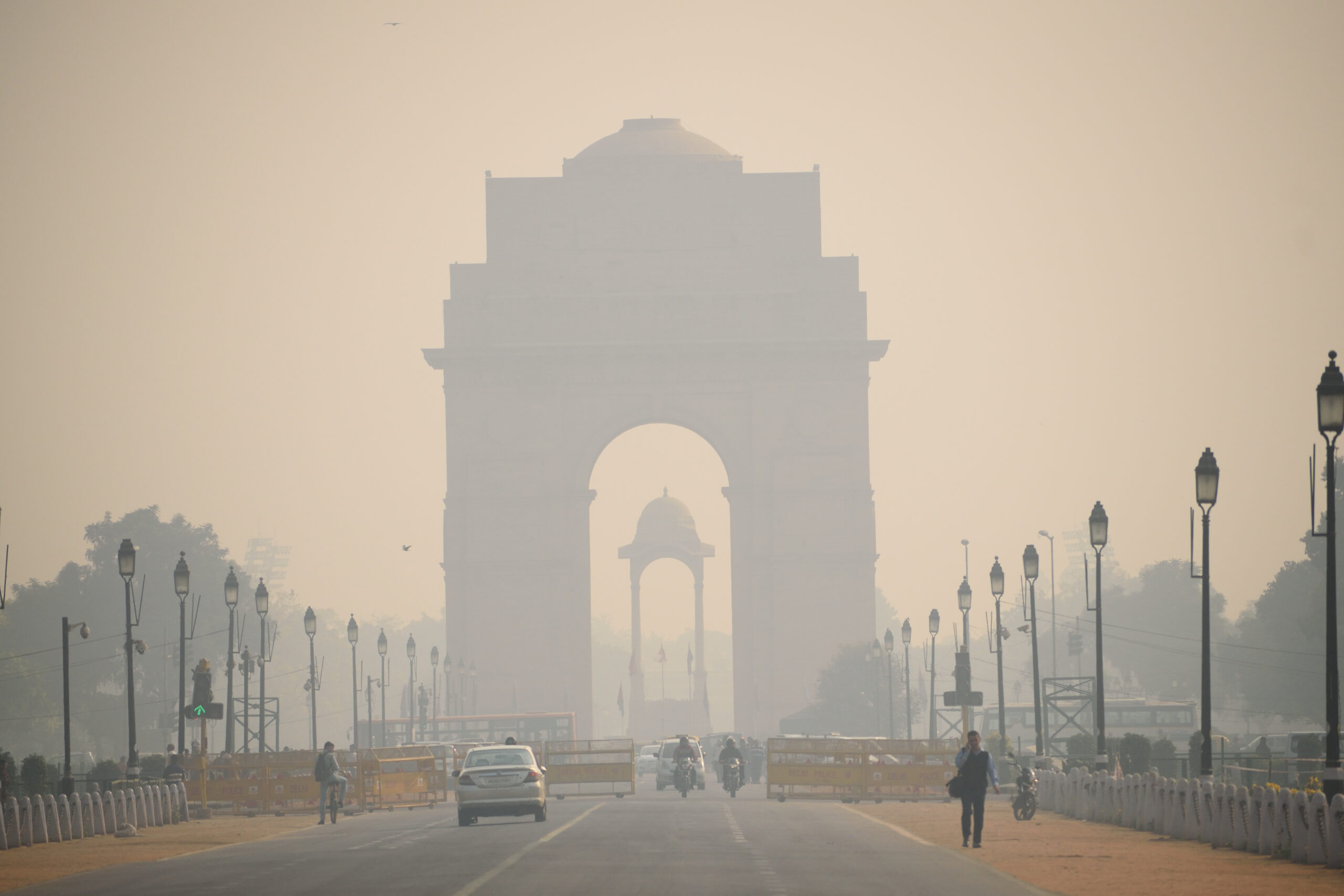
India is battling a slow, invisible emergency: air pollution that now blankets nearly 60% of its districts year-round. Delhi’s winter smog is only the tip of the iceberg. Can India learn from global clean-air success stories and reclaim the right to breathe?
Every winter, Delhi-NCR wakes up to the same unsettling sight: sun hiding behind a grey veil, horizon swallowed by haze, and clean air like a dream. Schools close, construction halts, flights diverted, and people hunting for N95 masks. Welcome to the air pollution saga!
But what if the air pollution isn’t just limited to Delhi-NCR and doesn’t actually begin in winter? A sweeping new satellite-based assessment — one of the most comprehensive studies of India’s air in recent years — revealed something alarming. A study shows that nearly 60% of India’s 749 districts suffer from unsafe, toxic air throughout the year.
Winter does not creates air pollution, it simply reveals the toxic air that has been accumulating for months. During winter, cold air traps pollutants and moisture mixes with particulate matter to form smog. So, the Delhi smog we dread after Diwali is not an isolated seasonal drama. It is just the tip of a vast nationwide air pollution iceberg, the sharpest expression of a chronic national illness. Air pollution in India is a crisis that spans seasons, states, and socio-economic boundaries.
A Study India Cannot Ignore
The assessment, conducted by the Centre for Research on Energy and Clean Air (CREA) using high-resolution satellite data, examined particulate matter (PM2.5) across India’s airsheds, states, and districts. The findings of the study, covering March 2024 to February 2025, are deeply unsettling.
Source: CREA
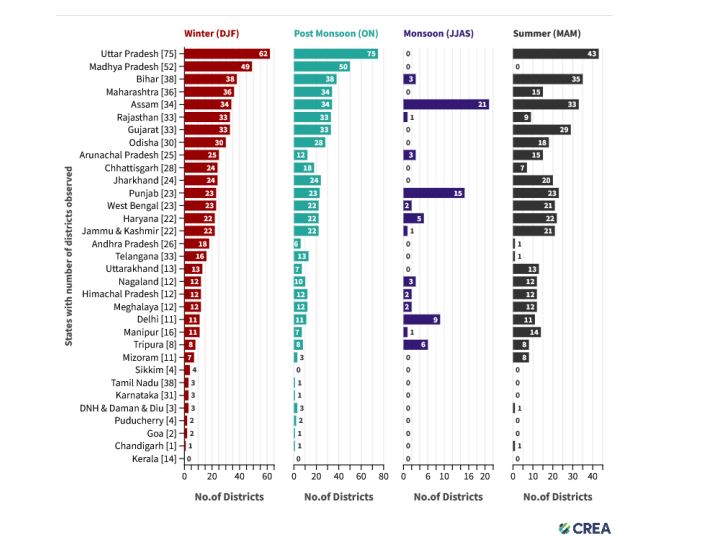
District-wise Analysis
- 447 out of 749 districts breached the national annual PM2.5 limit set by the National Ambient Air Quality Standard (NAAQS) of 40 µg/m³.
- The most polluted districts are in Delhi (11) and Assam (11) followed by Bihar (7) and Haryana (7), Uttar Pradesh (4), Tripura (3), Rajasthan (2), West Bengal (2), Chandigarh (1), Meghalaya (1) and Nagaland (1).
- Delhi, Tripura, Punjab, Haryana, Himachal Pradesh, Meghalaya, and Chandigarh saw the NAAQS limit exceeded in all the districts in all seasons, except monsoon.
- Maharashtra’s 14 districts exceed PM2.5 limit by NAAQS.
- Rural areas, small towns, and agricultural districts were equally affected by dangerous air quality.
State-wise Analysis
- All 33 states and UTs recorded PM2.5 concentration above the WHO guideline of 5 µg/m³. Out of these 28 were in breach of the limits of NAAQS, which is 8 times higher than the WHO’s.
- Delhi is the most polluted with a PM2.5 concentration of 101 µg/m³ which is 2.5 times the NAAQS and 20 times the WHO guideline.
- Northeastern states like Tripura and Assam are also facing increasing pollution.
- Northern India- especially the Indo-Gangetic Plain– showed persistent high PM2.5 levels throughout the year.
Season-wise Analysis
Source: CREA
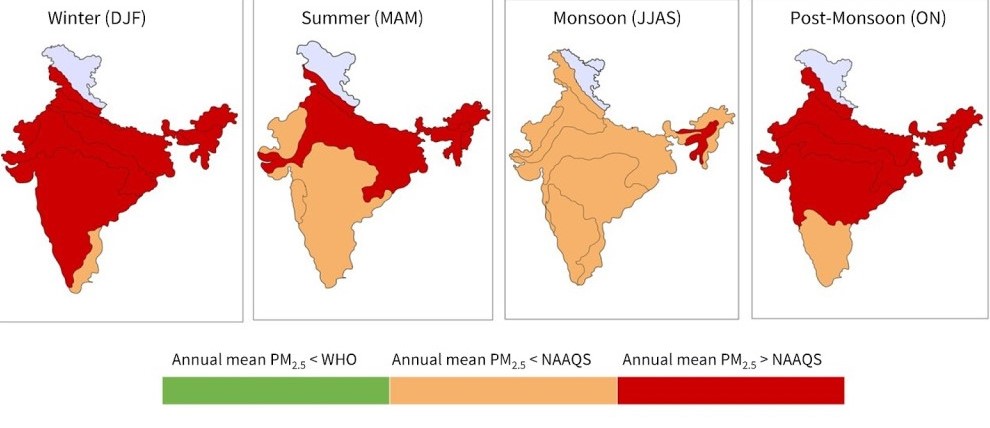
- In winter, 100% of districts of 22 out of 33 states record PM2.5 above the NAAQS limit.
- During monsoon, Assam, Delhi, Punjab, and Tripura exceed PM2.5 standards.
- Post-monsoon months see a sharp resurgence, with 566 of 749 districts exceeding the limit.
- In summer, most states see decline in pollution. Yet, 100% districts in 9 states report limit exceedance.
Learning from the World
Around the world, countries once trapped in toxic air have shown that pollution isn’t destiny — it’s policy. In the 1970s, U.S. cities like Los Angeles were as smog-choked as Delhi. Strong clean-air laws, strict vehicle standards, cleaner fuels and big monitoring networks cut particulate levels by over 40% in two decades.
China followed a similar path: after declaring a “war on pollution” in 2013, it shut or relocated polluting industries, curbed coal use and rolled out electric buses, driving Beijing’s PM2.5 down by nearly 40% in seven years.
London, the city that invented the word “smog” ,saw one of the most dramatic cleanups. After the Great Smog of 1952 killed 12,000 people, the UK banned coal burning in cities, set up Clean Air Zones and pushed households toward cleaner fuels. Over time, it phased out dirty fuels and restricted polluting vehicles. The deadly, choking smog events of the past never returned.
Even developing nations acted boldly: Mexico City cleaned up fuel and transport, while Bangkok slashed PM levels by shifting buses to CNG and tightening industrial rules. The lesson is universal: clean air takes steady, year-round, politically backed action — not seasonal quick fixes.
These global examples share a common thread that success came from: long-term, year-round, politically backed strategies — not seasonal firefighting. Constant air pollution is a policy failure — and policy can change.
India’s Call to Action for Air Pollution
India doesn’t need to reinvent solutions. What’s missing is sustained, nationwide implementation. The satellite-based PM2.5 analysis highlights that India’s air pollution challenge extends well beyond Delhi-NCR and demands broader measures:
1. Data Driven Policy
Use satellite and ground monitoring, ensure transparent real-time public data, build district-wise pollution inventories, target regional and sectoral emissions, incentivise state accountability, and adopt airshed-based management.
2. Clean Up Transport
Phase out old diesel vehicles, expand electric buses and green last-mile options, and strengthen public transport connectivity.
3. Fix Urban Planning
Mandate covered construction, improve road upkeep with mechanised sweeping, expand green buffers and low-emission zones, and ensure proper waste disposal.
4. Regulate Small Industries
Upgrade brick kilns, shift industries away from residential zones, ban diesel generators or mandate emission-control devices.
5. Ensure Clean Household Energy
Provide universal LPG/PNG access, promote electric cooking and heating, and prevent waste burning through stronger waste management.
6. Make Clean Air a Year-Round Mission
Winter bans and GRAP are just band-aids. India needs a permanent National Clean Air Mission 2.0 with clear targets, funding, and accountability.
The Bottom Line
Delhi’s winter smog captures headlines because it is impossible to ignore. But the real story is unfolding quietly across the country: a year-round assault on the air that millions breathe. The satellite study has made it impossible to look away. Other nations have proved that cleaner air is achievable.
India now stands at a pivotal moment. Act decisively, and the next generation will breathe more easily. Delay, and toxic air will soon become just one part of a much larger national health emergency.
Clean air is not a luxury. It is a right —Our Right to Breathe—and India can still win back.
Also Read: Research Highlights Alarming Plastic Pollution in Indian Households