
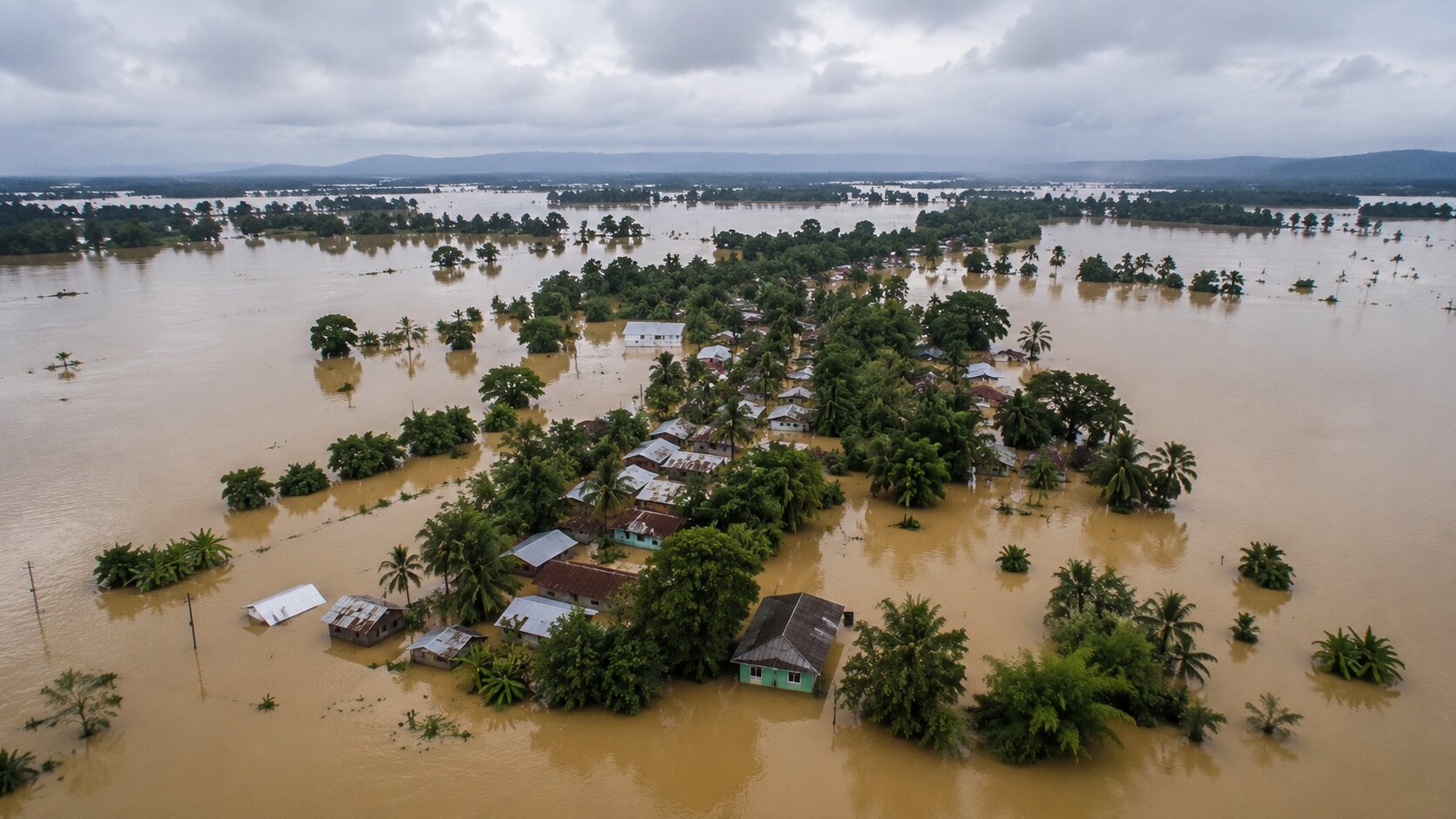
Assam’s floods are more than a seasonal tragedy. They are becoming a powerful reminder of how climate change, environmental degradation, and unchecked development are making natural disasters increasingly destructive.
For most people, the monsoon brings relief from scorching heat. In Assam, however, it often bring anxiety and trouble. Families living along the Brahmaputra and its tributaries know that a few days of relentless rain can change everything. They live with the possibility of leaving their homes at a moment’s notice. That fear became reality once again with the latest Assam floods.
As of 29 July 2026, Assam floods have claimed 75 lives, while more than 3 lakh people continue to be affected across the state according to official reports from the Assam State Disaster Management Authority. The disaster has inundated 622 villages and submerged45,341 hectares of crop land.
Assam’s floods are more than a seasonal tragedy. They are becoming a powerful reminder of how climate change, environmental degradation, and unchecked development are making natural disasters increasingly destructive.
The Never Ending Cycle
Assam floods don’t simply overflow river banks. They engulf homes, farms, schools and memories. Floods cause displacement and homelessness of thousands of people across the state, especially those residing in low-lying areas.
Within hours, standing crops disappear beneath flood water. Families lose livestock—their primary source of income. People move to higher areas and stay in makeshift shelters. Some people remain on the roof of their homes or in boats and improvised rafts until the flood recedes. For weeks, people would have to survive on fruits or plantain.
Drinking water becomes contaminated. Post-flood, there is a higher chance of spreading epidemics such as water-borne diseases and skin infections. Many low-lying areas remain waterlogged for many months. Children miss school for weeks.
Floods have also severely disrupted telecommunication & power networks, and shattered transport infrastructure. The Assam floods this year have damaged over 900 roads and destroyed 52 bridges alongside inundated railway tracks and disrupted services in upper Assam.
According to the Associated Press, nearly 700,000 people were displaced during the peak of the flooding this year, with around 300,000 people taking shelter in government relief camps. For families who have experienced this cycle year after year, rebuilding has become a painful routine.
What Causes Assam Floods Every Year?
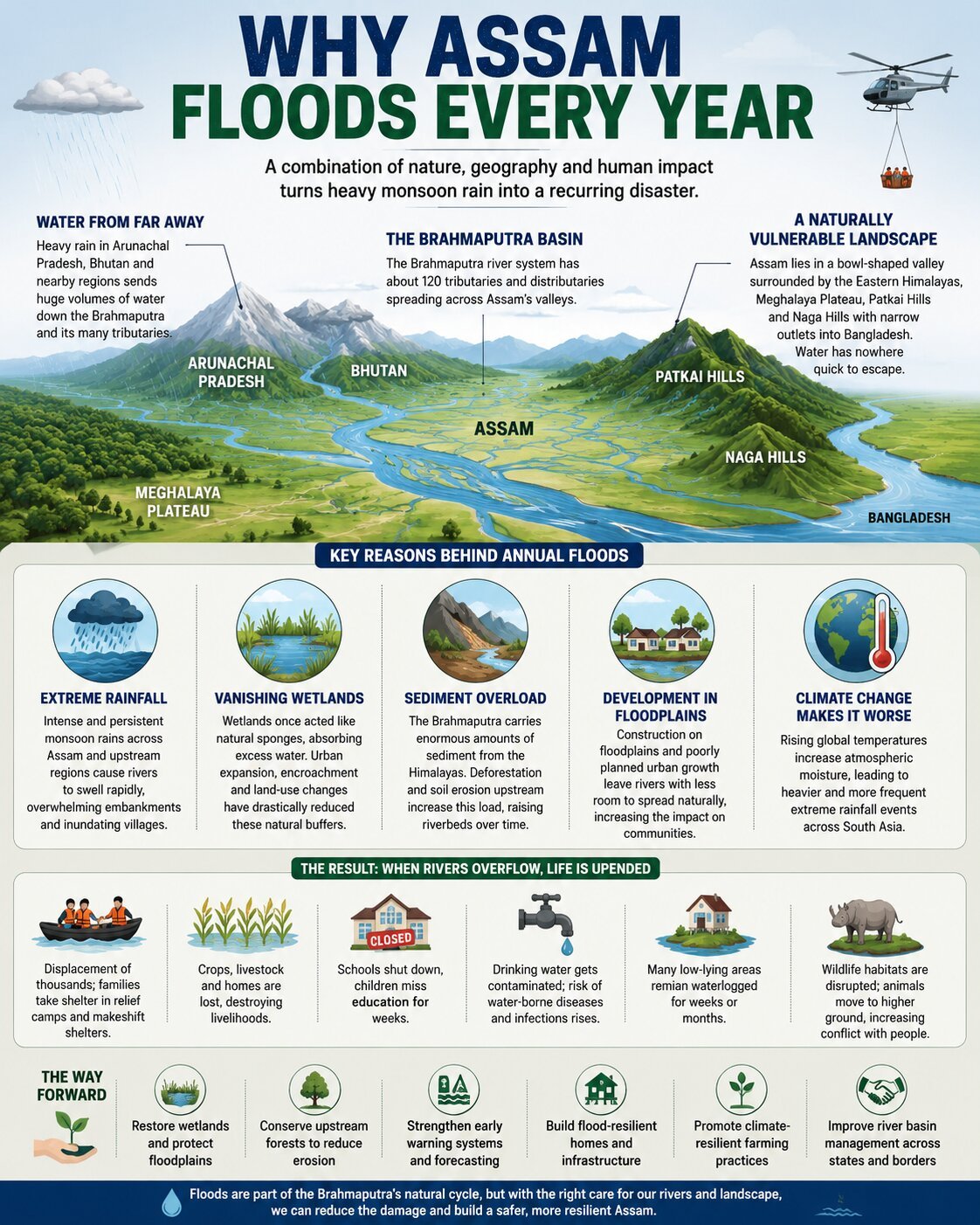
The answer lies in a combination of geography, climate and the mighty Brahmaputra River.
Assam lies in a narrow valley surrounded by steep mountain ranges, the Eastern Himalayas to the north, the Patkai Hills and Naga Hills to the east and southeast, and the Meghalaya Plateau to the south. It’s geographical alignment — divided into two valleys surrounded by hill States with narrow outlets into Bangladesh — makes it prone to flooding even if it rains heavily in the hills of Arunachal Pradesh or Bhutan.
Ancient texts have regarded Assam as a waterscape, academician Arupjyoti Saikia wrote in The Unquiet River: A Biography of the Brahmaputra. Assam is said to contain more rivers than any equal extent of territory in the world. Brahmaputra braided river system has about 120 tributaries and distributaries.
Every flood season, the mighty Brahmaputra River is blamed for the destruction. But the river itself is not the problem. For centuries, it has overflowed during the monsoon, depositing nutrient-rich sediments that make Assam’s floodplains among the most fertile in India. Flooding, in other words, is natural. What is changing is its intensity due to climate change.
Scientists and environmental experts point to a combination of factors that are amplifying the damage:
- Extreme Rainfall: Persistent monsoon rains across Assam and neighbouring upstream regions caused rivers to swell rapidly this year, overwhelming embankments and inundating villages.
- Vanishing Wetlands: Wetlands once acted like natural sponges, absorbing excess water during heavy rainfall. However, urban expansion, encroachment, and land-use changes have significantly reduced these natural buffers.
- Sediment Overload: The Brahmaputra carries enormous amounts of sediment from the Himalayas. Deforestation and soil erosion upstream increase this sediment load, gradually raising riverbeds and making rivers overflow more easily.
- Development in Floodplains: Construction on floodplains and poorly planned urban growth leave rivers with less room to spread naturally, increasing the impact on nearby communities.
Together, these factors turn seasonal flooding into a disaster.
The Weather We Created
Climate change alone does not cause the flood. But scientists increasingly agree that climate change is making extreme rainfall more likely. Scientists say climatic uncertainty is the “new normal” and no part of Assam or the rest of the north-eastern region can or hope to stay unaffected.
According to the Intergovernmental Panel on Climate Change (IPCC), rising global temperatures allow the atmosphere to hold more moisture, leading to heavier rainfall events across South Asia. This means places like Assam are likely to experience more frequent and more intense flooding in the coming decades.
By the late 20th century, 40% of the valley’s total land area was regularly inundated by the annual floods. With the increasing rate of global warming and climate change, there is no doubt that more than 40% of the land areas are prone to periodic floods.
When Nature Runs for Cover

Floods don’t only affect people. They reshape entire ecosystems. As forests, wetlands, and grasslands disappear underwater, wildlife is forced to search for higher ground, often entering villages or crossing highways in the process.
This is especially visible in Kaziranga National Park, home to the world’s largest population of the one-horned rhinoceros. Floodwaters submerge up to 75% to 95% of the park’s total area when rivers like the Brahmaputra breach danger marks.
Seasonal floods have always been part of Kaziranga’s ecology. They replenish wetlands, maintain grasslands, and support biodiversity. The recent Assam floods are inundating multiple forest camps, submerging large parts of the park area, and forcing vulnerable wildlife to migrate toward the higher elevations of the Karbi Anglong hills.
Increasingly severe floods also lead to wildlife deaths, habitat disruption, and greater conflict between animals and people. Protecting ecosystems, therefore, is not separate from protecting people—they are deeply connected.
Living Between Floods
One of the saddest realities is that Assam’s floods are no longer shocking.
Every year, rescue boats return, relief camps fill, and families rebuild homes they may lose again the following monsoon.
According to The Times of India, more than 2,200 people have died in flood-related incidents in Assam over the past 26 years.
These aren’t isolated tragedies. They are signs of a long-term environmental challenge that demands long-term solutions
Beyond Rescue and Relief Operations
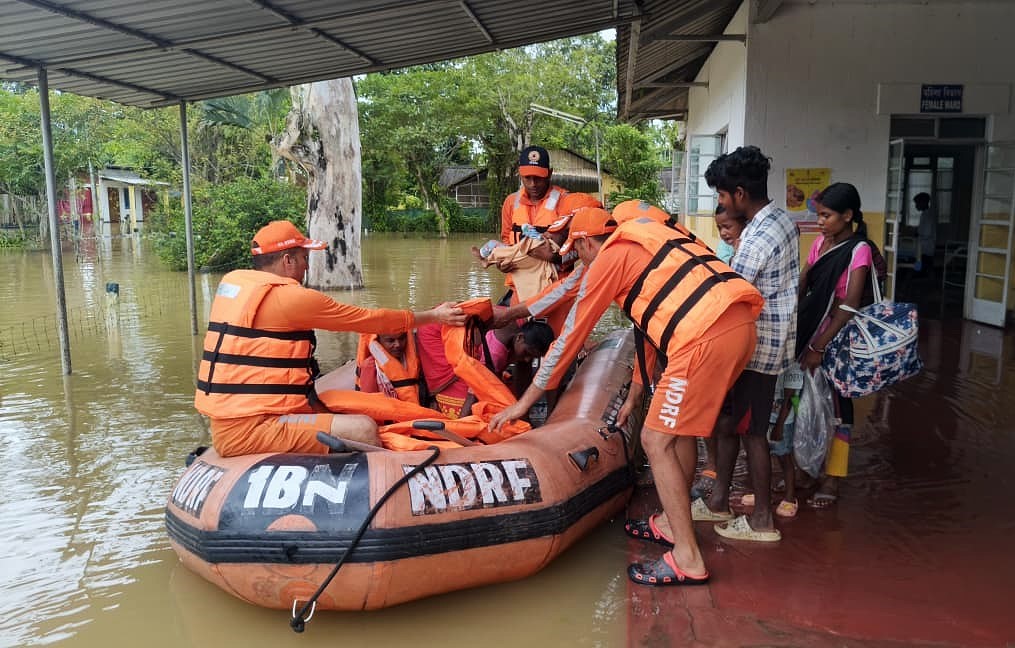
Rescue teams from the National Disaster Response Force (NDRF), State Disaster Response Force (SDRF), the Army, and local volunteers have worked tirelessly to evacuate stranded families and deliver food, medicines, and clean drinking water. In several remote locations, helicopters had to air-drop relief materials after floodwaters cut off road access. Government agencies continue to provide healthcare and temporary shelter.
Assam Chief Minister Himanta Biswa Sarma has announced a comprehensive relief and rehabilitation package for affected families, including enhanced compensation, cash assistance, educational support and compensation for damaged property.
These efforts are essential. But emergency relief cannot become the only response. Environmental experts say Assam needs a strategy that works before floodwaters arrive.
Such measures include:
- Restoring wetlands that naturally absorb excess water.
- Protecting floodplains from encroachment.
- Improving river basin management across states and neighboring countries.
- Investing in stronger early warning systems.
- Building flood-resilient homes and public infrastructure.
- Promoting climate-resilient farming practices.
- Conserving forests in upstream catchments to reduce erosion.
Planning Beyond the Monsoon
The floodwaters will eventually recede. Roads will reopen. Children will return to school. Farmers will sow crops again. Life, as it always does in Assam, will slowly begin to rebuild. But unless deeper environmental challenges are addressed, the next monsoon may bring the same story all over again.
The latest Assam floods are not simply another disaster headline. The Assam government has told the 126-member Assembly on that the situation has been the worst in 60 years. They are a warning that healthy rivers need healthy floodplains, wetlands are worth protecting, and climate resilience can no longer remain a policy discussion—it must become a national priority.
Experts say floods in Assam cannot be eliminated because they are part of the Brahmaputra’s natural cycle. In fact, seasonal floods replenish fertile soils, sustain wetlands like Kaziranga National Park, and support agriculture and fisheries.
The challenge is reducing their destructive impact through better flood forecasting, restoring wetlands that act as natural sponges, strengthening embankments where appropriate, improving drainage, and avoiding construction on floodplains.
Every monsoon, Assam reminds us of an uncomfortable truth. Nature always finds space for water. The real question is whether we will make space for nature before the next flood does it for us.
You may also read- Climate Crisis in India: More heatwaves and rainfall by 2030