
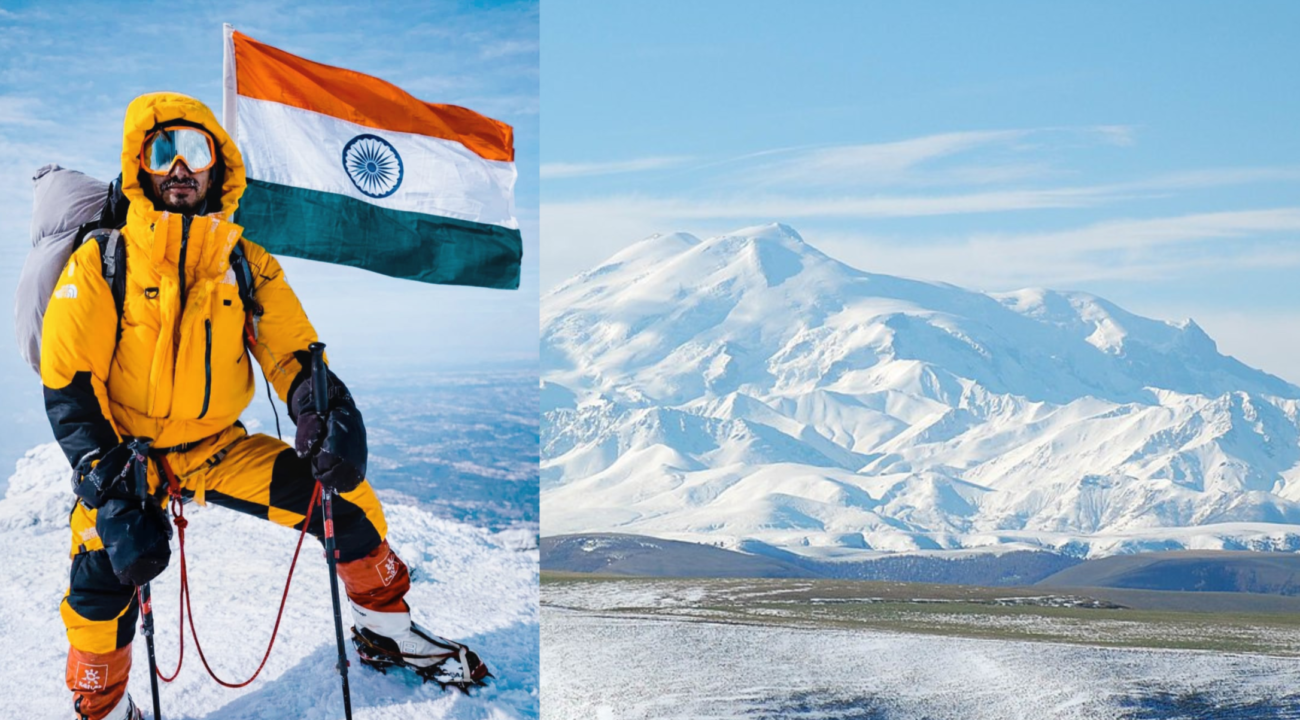
From a Haryana village to Europe’s highest peak, Rohtash Khileri’s record-breaking climb is also a lesson in environmental respect.
At over five thousand metres above sea level, the mountain decides everything. The air is thin. The cold bites deep. Even simple movements feel heavy. At this height, nature does not reward speed or ego — it rewards patience, preparation, and respect.
In January 2026, Indian mountaineer Rohtash Khileri stood on the summit of Mount Elbrus (5,642 metres) — not for a few photographs or quick recognition, but for 24 continuous hours. He did this without using supplemental oxygen, relying only on his body, breath, training, and deep respect for the mountain.
Battling−40 degree Celsius temperatures and winds over 60kmph, he accomplished this feat after eight years of preparation and failed attempts, highlighting exceptional endurance and mental strength.
This historic achievement made global headlines. But beyond the record itself, Rohtash’s journey carries an important message for our times: true strength lies in understanding nature, not overpowering it.
Roots Close to the Land
Rohtash Khileri was born on May 14, 1996, in Malapur village in Hisar, Haryana, into a farming family. Life in the village was shaped by seasons, weather, and hard physical work. From an early age, he learned that nature cannot be controlled — only understood and adapted to.
Before mountaineering entered his life, Rohtash trained in wrestling, boxing, and taekwondo. These sports built strength and discipline, but his deeper connection with nature came from growing up close to the land, where rain, heat, and soil decide outcomes.
Those early lessons would later guide how he approached the mountains.
Discovering the Mountains — and Their Fragility
In 2014, Rohtash saw the mountains up close for the first time. Their beauty was undeniable, but so was their seriousness. He felt he has found his true calling.
Determined to learn properly, he trained at the Jawahar Institute of Mountaineering in Pahalgam and later at the Nehru Institute of Mountaineering in Darjeeling. Here, he learned technical climbing skills, safety, and an important principle: the mountains demand humility.
A Dream Supported by Sacrifice
Mountaineering is expensive and uncertain. To support Rohtash’s dream of climbing Mount Everest, his father took a difficult step — mortgaging family land. It was a quiet sacrifice made without guarantees.
In May 2018, Rohtash successfully summited Mount Everest. During the climb, he paused to help a fellow climber who was in serious trouble. At extreme altitude, even stopping briefly can be risky, yet he chose human life over speed. He later reached the summit, carrying that moment with him.
Choosing Endurance Over Speed
As his experience grew, Rohtash shifted focus. Instead of quick ascents, he became interested in how the human body adapts naturally to altitude, without artificial support. Each climb reinforced his belief that slow, mindful endurance is more sustainable than aggressive conquest.
His journey reminds us that progress can be quiet, that patience is a strength, and that real success lies in knowing when to push — and when to pause.
Rohtash Khileri’s Achievements:
- 🏔️ Mount Everest summit (Date: 16 May 2018, Altitude: 8848m)
- 🌍 Mount Kilimanjaro (Summitted Twice– Dates: 23 July 2018 and 21 March 2021, Altitude: 5895m, stayed on peak in 2021 for 24 hours, earning recognition in the India Book of Records)
- ❄️ Mount Elbrus (first Indian to climb in both summer and winter Dates: 4 September 2018, 1 February 2020 and 20 January 2026, Altitude: 5642m)
- 🧗 Solo climb of Friendship Peak (Date: 9 October 2020, Altitude: 5286m)
- ⛰️Renok Peak (Date: 4 October 2017, Altitude: 5200)
- 🌄Mount Moon Peak (Date: 1 November 2020, Altitude: 4650m)
- 🏅 Recommended for the Tenzing Norgay National Adventure Award (2021)
Mount Elbrus: Where Nature Sets the Rules
Rising 18,510 feet above sea level in Russia’s Caucasus range, Mount Elbrus is Europe’s tallest mountain and one of the famed Seven Summits. Wide slopes hide sudden storms, powerful winds, and dangerously low oxygen levels. Staying at the summit for long durations is extremely risky.
Known for its massive glaciers, brutal winds and extreme cold, the peak poses serious risks even to seasoned climbers, making Rohtash Khileri’s achievement all the more remarkable.
Rohtash attempted his 24-hour stay more than once. In 2020, while attempting a long-duration summit stay, worsening conditions put his guide’s life at risk. Rohtash made a clear choice — he abandoned the attempt and descended to save the guide, ending months of preparation without hesitation.
Another attempt in 2023 was cut short due to severe weather. Instead of forcing success, he waited.
Moments of Humanity: Choosing Life Over Records
High-altitude climbing often celebrates pushing limits. Rohtash Khileri’s journey stands out because he knew when to stop.
On Mount Everest in 2018, he paused to help a climber in distress, even though it slowed his own progress. On Mount Elbrus in 2020, he gave up a record attempt to save his guide’s life.
These moments reveal the values behind his achievements. For Rohtash, mountains are not spaces for ego — they demand empathy, responsibility, and respect for both people and nature.
The Historic 24 Hours
In January 2026, conditions finally aligned. After reaching the summit of Mount Elbrus, Rohtash stayed. Without oxygen support, his body relied entirely on natural acclimatisation. He moved slowly, conserved energy, and listened closely to his limits.
As night fell, temperatures dropped sharply. Winds strengthened. Oxygen levels fell even further. Still, he remained calm and alert.
For 24 hours, Rohtash shared space with the mountain — careful, patient, and respectful. When he finally descended safely, he became the first known human to spend 24 hours on Mount Elbrus without oxygen.
The journey also came at a high physical cost. In his X post, Rohtash Khileri spoke about suffering severe frostbite during earlier expeditions, resulting in permanent damage to two of his fingers.
Why This Record Matters in a Climate-Stressed World
High-altitude regions are among the most climate-sensitive ecosystems on Earth. Melting glaciers, unpredictable snowfall, and extreme weather events are becoming more common.
Rohtash’s approach sends a powerful message:
- Human endurance can reduce dependence on equipment
- Preparation can replace excess resources
- Respect can prevent disaster
His climb reminds us that sustainable exploration is possible, even in extreme environments.
Rooted, Responsible, and Looking Ahead
Despite global attention, Rohtash remains grounded. He often speaks about responsibility — toward nature, fellow climbers, and future generations. For him, mountains are not trophies. They are teachers.
He hopes his journey encourages young people to pursue adventure without exploiting the environment, and to understand that progress does not always mean faster, higher, or louder. Sometimes, it means slower, quieter, and wiser.
In a world rushing toward more, faster, and higher, his 24 hours on Mount Elbrus send a simple but powerful message: Nature does not need to be defeated. It needs to be listened to. And when humans learn to work with nature — not against it — both endurance and balance become possible